
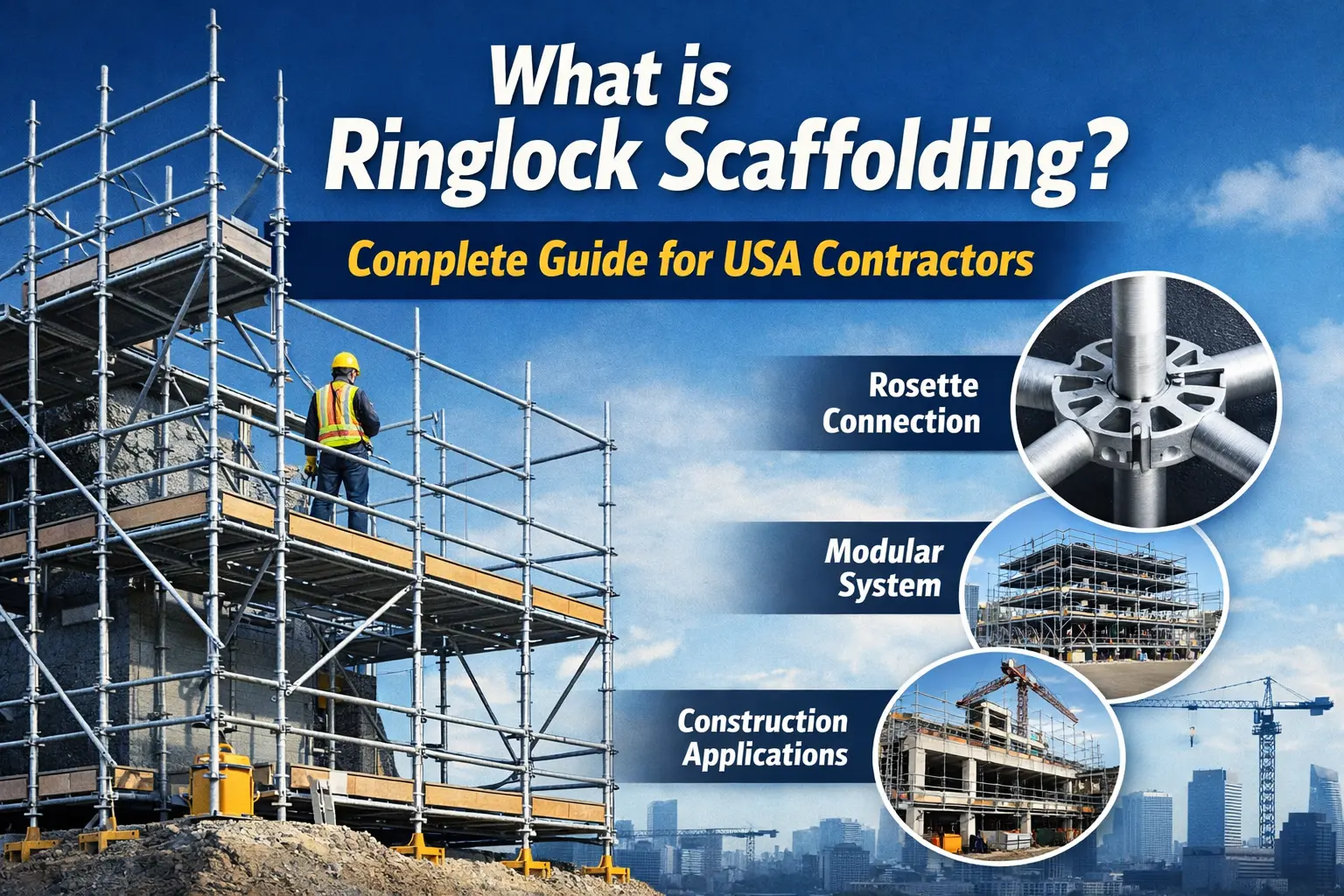
Ringlock Scaffolding- Complete Guide for USA Contractors
Ringlock scaffolding is one of the most used types of modular scaffolding systems in contemporary construction. USA-based construction companies specializing in commercial construction, industrial maintenance, infrastructure projects, and building facades have found the ringlock scaffolding system to be an ideal solution to traditional scaffolding systems due to its speed, strength, and flexibility.
Unlike traditional scaffolding systems, which are known to have more loose parts and longer construction times, the ringlock scaffolding system is designed to provide speed, strength, and flexibility to construction projects. Its modular construction enables construction workers to build strong and secure scaffolding platforms even on complex construction projects where traditional frame scaffolding systems cannot be used.
In this section, we will learn what ringlock scaffolding is, how it works, where it is used, and why USA-based construction companies prefer using the ringlock scaffolding system on construction projects.
What Is Ringlock Scaffolding?
Ringlock scaffolding is a type of modular scaffolding system consisting of vertical standards with fixed rosettes at regular intervals. The horizontal members and diagonal braces are connected to the rosettes using wedges.
As the system is modular, it can be designed to suit a multitude of access requirements. Contractors can utilize ringlock scaffolding in the construction of straight elevation scaffolding, curved façades, stair towers, loading bays, birdcages, industrial maintenance scaffolding, etc.
In effect, the ringlock scaffolding system provides contractors with an efficient means of providing safe access platforms while keeping labor costs to a minimum.
How Does a Ringlock Scaffolding System Function?
The ringlock scaffolding system works in the following manner: the vertical standard has a circular rosette welded in a predetermined interval. The ledgers, braces, etc., are then attached to the rosette via a wedge connection.
This enables several members to attach to one point, which increases the stability of the ringlock scaffolding system while allowing the contractor to make the most of the flexibility in the system’s design.
In effect, the ringlock scaffolding system provides contractors with the following benefits:
- Faster Erection and Dismantling of the Scaffolding
- Less Couplers Required
- Improved Alignment of the Scaffolding Members
- Increased Adaptability of the Scaffolding on Irregular Structures
- Increased Performance in Medium to Heavy-Duty Applications
Main Components of Ringlock Scaffolding
The main components of a ringlock scaffolding system include:
Standards
These are the uprights of a scaffold structure, and they take the weight down from the top and incorporate a rosette, allowing multiple connections to be made.
Ledgers
These are the horizontal components that connect two or more uprights, providing lengthwise support to a scaffold structure.
Diagonal Braces
These are incorporated into a scaffold structure to improve stability, reducing sway and overall movement.
Base Jacks
Base jacks are installed at floor level and are used to level a scaffold structure, providing a stable foundation from which to begin building upwards.
Steel Planks or Platforms
These components are used to create a platform, providing a surface for laborers, tools, and materials to be placed.
Guardrails and Toe Boards
These components are used to improve laborer safety, ensuring that they do not slip off a scaffold platform and materials do not fall off a platform either.
Stair Units and Access Components
These components improve laborer safety and ease of movement, especially in a commercial or industrial setting, where a scaffold structure may be large and multi-storyed.
Why USA Contractors Use Ringlock Scaffolding?
USA contractors use ringlock scaffolding because it enhances job site efficiency, safety, and strength.
One major reason why USA contractors use ringlock scaffolding is that it enhances efficiency. The fact that this type of scaffolding uses a modular locking system means that, in comparison, contractors will be able to construct and dismantle scaffolding much faster. As a result, there will be less labor pressure.
Another reason why USA contractors use ringlock scaffolding is that this type of scaffolding system is versatile. The fact that a ringlock scaffolding system can be used in various applications, including new construction, shutdowns, maintenance, bridge work, and tricky facades, means that this type of scaffolding has much more value.
This type of scaffolding system has been shown to be strong and stable. The fact that ringlock scaffolding has strength and stability means that, when required, this type of scaffolding will be able to support job sites.
Common Applications of Ringlock Scaffolding
Ringlock scaffolding has a variety of uses in different industries and working conditions in the USA.
Some common applications include:
- commercial building construction
- mid-rise and high-rise residential building construction
- bridge building and repair
- industrial plant maintenance
- refinery shutdown and maintenance
- power station access scaffolds
- shipyard maintenance scaffolds
- façade access and restoration scaffolds
- birdcage scaffolds for interior use
- loading towers and stair towers
The variety of uses for ringlock scaffolding is one reason why many contractors prefer to use this type of scaffolding, especially when they want a system that can be used for different types of jobs.
Ringlock Scaffolding vs Traditional Scaffolding
It has also been compared to other types of scaffolding, such as tube and clamp, frame scaffolding, and cuplock scaffolding, among others, before deciding what would be most appropriate for a particular job.
Ringlock vs Tube and Clamp
While tube and clamp scaffolding has many advantages, such as flexibility in terms of design, it takes a longer time to assemble, especially when compared to ringlock scaffolding, which relies on individual couplers and manual connections.
Ringlock vs Frame Scaffolding
Frame scaffolding is best suited for use in straightforward access work, though limited in more complicated situations, especially in industrial settings. The ringlock scaffolding system has more flexibility.
Ringlock vs Cuplock
Cuplock scaffolding is a modular system, similar to ringlock, though ringlock scaffolding is more suitable when more connection options are required.
For contractors concerned with productivity, ringlock scaffolding is likely the best option.
Key Benefits of Ringlock Scaffolding for Contractors
The ringlock scaffolding system, if selected appropriately, has several advantages, including performance and planning.
Faster Assembly
The wedge-lock mechanism minimizes time required during assembly.
Strong Structural Stability
The rosette connection mechanism creates a rigid structure, making it suitable for use in challenging situations.
Flexible Design
The ringlock scaffolding system has flexibility, allowing users to design various configurations, including facades, corners, circular configurations, access towers, and interior support.
Reduced Labor Burden
The reduced time required during assembly minimizes labor burdens.
Durable for Repeated Use
Galvanized materials ensure a longer lifespan, making ringlock scaffolding suitable for use in challenging situations.
Better Material Handling Options
The system can accommodate working platforms, loading bays, and access options more effectively than a standard system.
Safety Considerations for Ringlock Scaffolding
Although ringlock scaffolding has a reputation for strength and stability, its safe use ultimately relies on proper planning, erection, and inspection.
Contractors must always:
- Ensure proper base preparation before erecting a scaffold.
- Ensure compatibility and condition of materials.
- Ensure proper decking of platforms.
- Ensure proper installation of guardrails and toe boards.
- Adhere to load limitations.
- Ensure proper installation of scaffold ties and braces.
- Ensure safe and clear definition of access points.
- Ensure regular inspections are carried out during use.
Safe use of a scaffold, regardless of its strength and stability, must consider site requirements, engineering needs, and OSHA compliance considerations, among other requirements.
How to Choose the Right Ringlock Scaffolding Supplier
Not all ringlock scaffolding suppliers are the same when it comes to quality and consistency of product and service. This is especially important to consider for USA-based contractors who are looking to source ringlock scaffolding supplies.
Here are some things to look for in a ringlock scaffolding supplier or manufacturer:
- Consistent dimensional accuracy
- High-quality steel
- Galvanized finish
- Consistent component compatibility
- Ability to supply in bulk
- Ability to support export and logistics
- Clear product specifications
- Quick turnaround on RFQs
Contractors should also consider whether the ringlock scaffolding supplier can support long-term project requirements and the ability to source replacement components and additional bulk supplies.
Why Ringlock Scaffolding Is a Smart Investment for Contractors
Ringlock scaffolding is more than just a platform on which to work. It’s a tool that can help improve the efficiency of a project and the overall ability of a contractor to get the job done on time and on budget.
This is because the system is designed to be reused over multiple jobs and is flexible enough to be adapted to multiple uses. The contractor is not merely purchasing components, they are investing in a system that can increase productivity from job to job.
This is why ringlock scaffolding remains an excellent solution for commercial construction, industrial service, infrastructure, and distributors focused on the USA construction market.
Request a Quote for Ringlock Scaffolding
Are you and your crew sourcing ringlock scaffolding components as part of a commercial construction, industrial, or bulk distribution project? If you are, then the key is to find the right supplier to meet your needs. The ideal supplier will have the expertise, product consistency, and ability to fulfill bulk orders with confidence.
Are you looking for standards, ledgers, braces, decks, base jacks, or an entire ringlock scaffolding system? The ideal solution will enable you and your crew to complete the job faster, safer, and more efficiently.
FAQ
Ringlock scaffolding is used for construction access, facade work, industrial maintenance, bridge projects, stair towers, loading bays, and other applications where safe elevated work platforms are needed.
The main parts include standards, ledgers, diagonal braces, base jacks, steel planks, guardrails, toe boards, and access components such as stair units.
Contractors prefer ringlock scaffolding because it is faster to assemble, structurally strong, flexible in layout, and suitable for a wide range of project types.
For many projects, yes. Ringlock scaffolding often offers faster setup, improved flexibility, and better efficiency than many traditional systems, especially on complex or large-scale sites.
Yes. Ringlock scaffolding is widely used on commercial projects because it supports safe access, adaptable configurations, and efficient installation.
Choose a supplier based on product quality, galvanized finish, component compatibility, bulk supply capability, delivery support, and responsiveness to project requirements.